X
Welcome to Ceramic Review
Ceramic Review is the magazine for contemporary and historical ceramics, ceramic art and pottery.
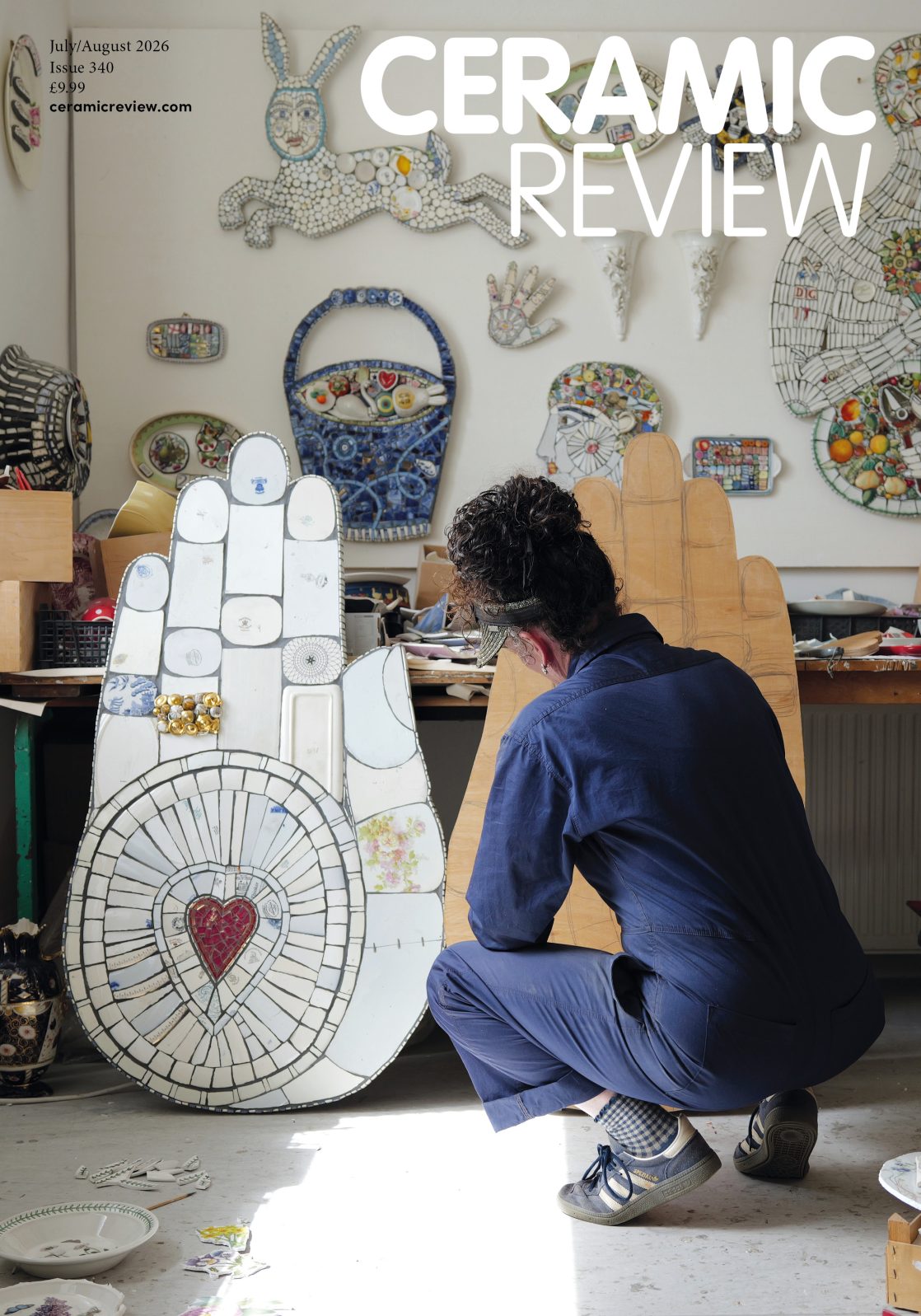
Ceramic Review Issue 340
July/August 2026
Ceramic Review is the magazine for contemporary and historical ceramics, ceramic art and pottery.
July/August 2026
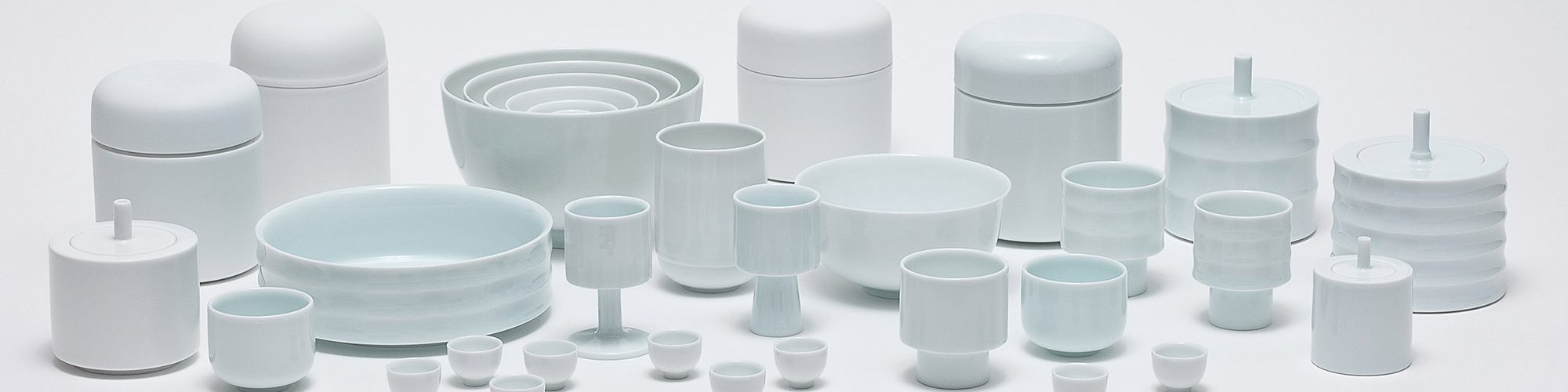
As Jaejun Lee departs the UK to return to his native South Korea, Ashley Thorpe looks back at the development of his work during his time in Britain
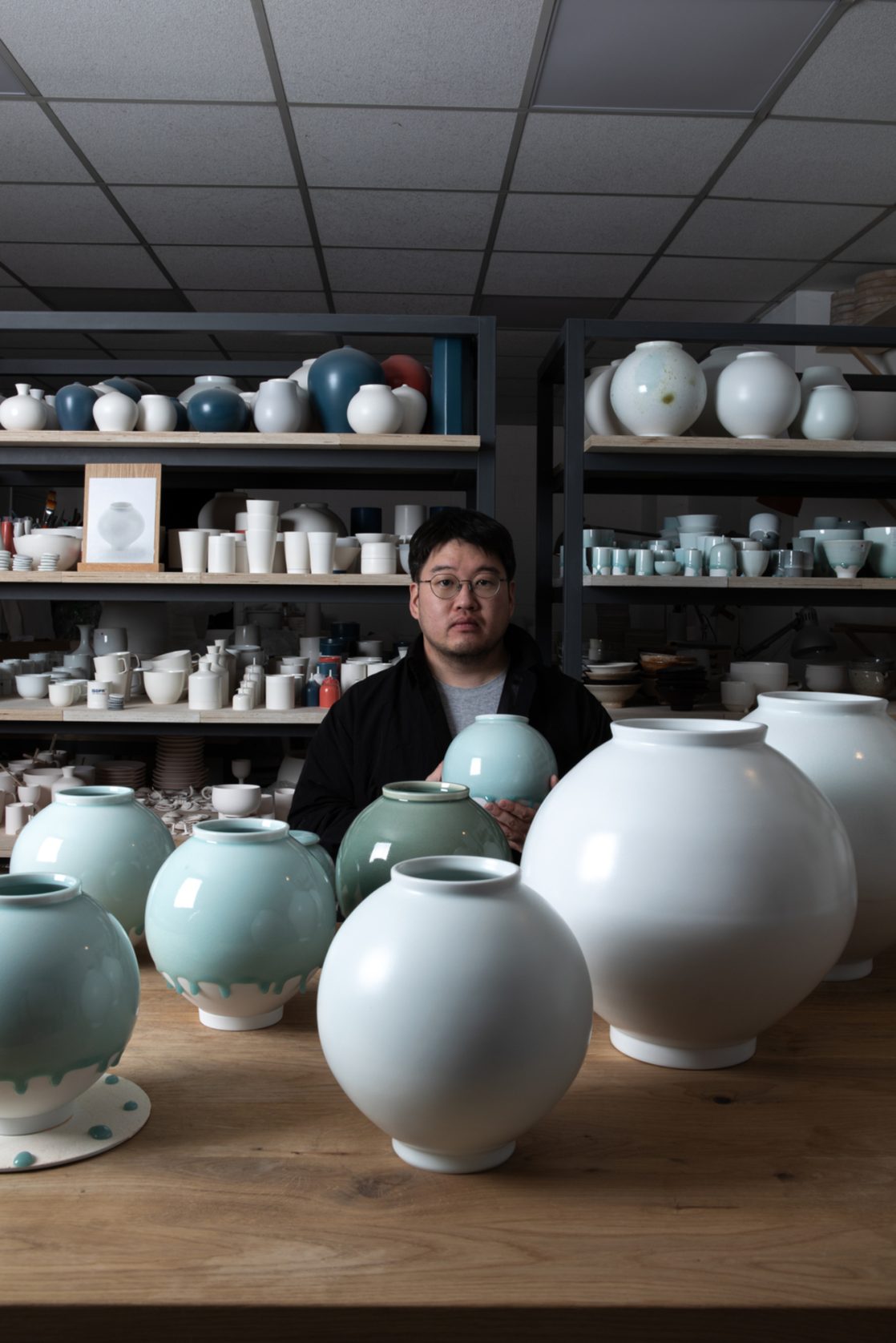
The 100 or so year history of British studio pottery is bound up with border crossings. The revered trinity of 20th-century ceramicists – Bernard Leach, Lucie Rie and Hans Coper – were all born outside of the UK. The cross-cultural legacies of these masters construct British studio pottery as a melting pot of different traditions, forms and technical approaches. British studio pottery is British in the sense that it has occurred within its territory; in reality, it is an international ecology that moves beyond the narrow rhetorics of nationalism.
FUNCTIONAL LIBERATION
Jaejun Lee was born in South Korea, studying for a BFA (2013) and then an MFA (2018) in Ceramics at Seoul National University. In Korea, ceramic traditions have remained relatively conservative, demanding certain standards in the production of domestic ware. Indeed, the studio craft system did not emerge in Korea until the 1980s, and even today there remains something of a delineation between those who adhere to tradition, pursue their own independent path, and those who bridge the gap between the two.
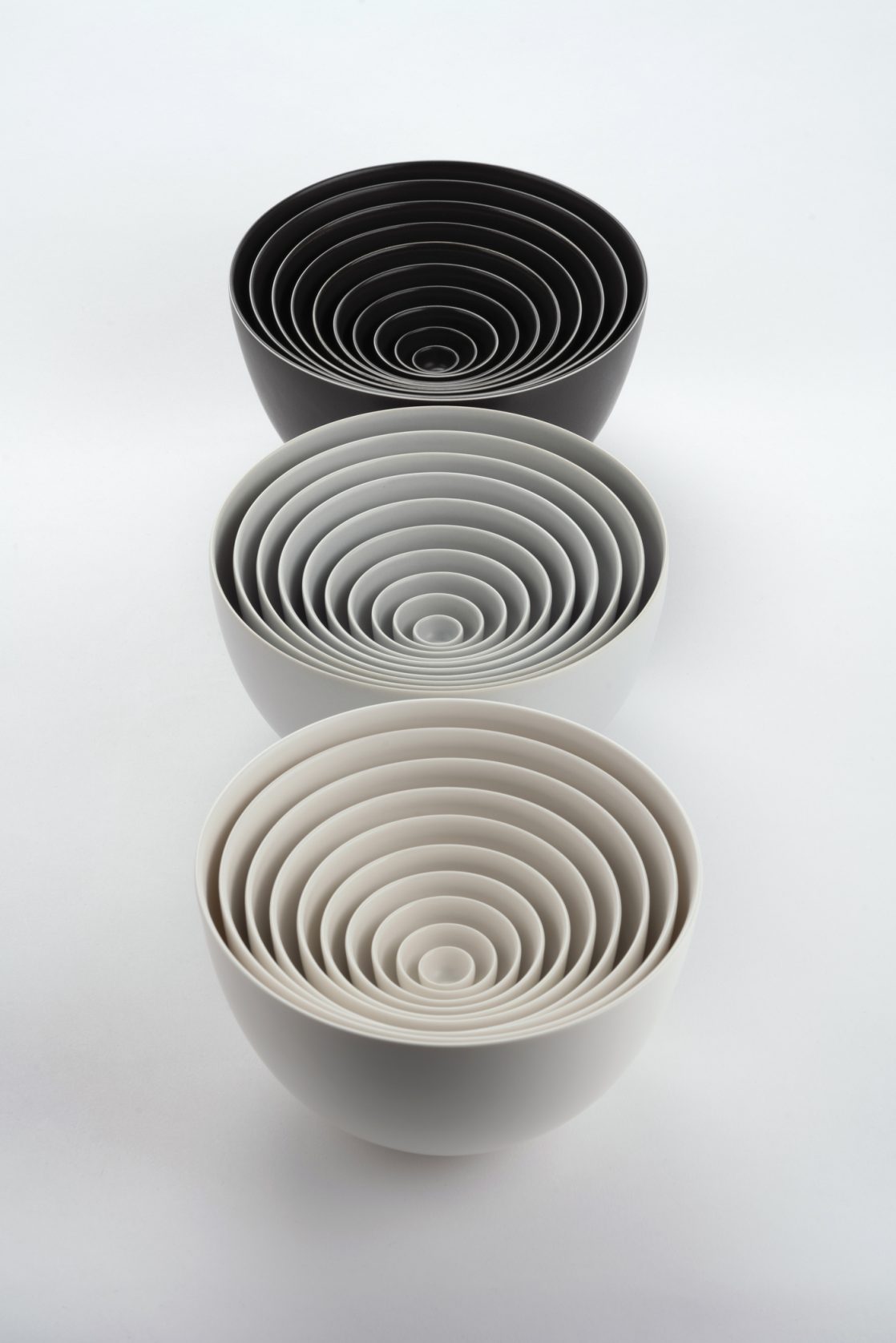
Before he arrived in the UK, Lee produced white porcelain reduction fired forms, which included cups, bowls and lidded containers, as well as the nesting bowl sets that have remained a distinctive part of his output. But, through rigorous experimentation, his practice started to mutate. Forms were still produced from white porcelain, but sections of the body were created in pigmented porcelain in vivid blues, reds and whites.
Unsure that Korea was the right context for this kind of work, and perceiving a diversity in British ceramics, Lee moved to the UK in 2018 to set up a studio in Cardiff. The impact of this decision was almost immediate: ‘I came to the UK and experienced a kind of liberation,’ reveals Lee. ‘I realised that the strict formal requirements of Korean tableware didn’t hold the same weight here. That freedom led me to experiment with bold colours and dry, matte glazes that wouldn’t have been considered suitable for functional use. And, as I searched for forms that could harmonise with those glazes, my interest gradually expanded to shapes that served no specific function.’
Yet, the move was far from a romantic idyll. Lee arrived in Wales just one year before the Covid-19 global pandemic and concomitant national lockdowns. A change in cultural context and working in a non-native tongue only served to increase his sense of isolation. Setting up a studio with limited means is never easy. His kilns proved unreliable (leading to a high failure rate in firing), and he needed to import clays from Korea to get the results he was looking for. Nevertheless, by harnessing the strict work ethic that had been fostered in him at Seoul National University, Lee produced a staggering number of pots in Cardiff. In this, his success reveals a well-trodden path in British studio pottery, one that had already been pursued by Leach, Rie, and Coper: stylistic hybridisation. Lee sought to diversify Korean forms and techniques in a context more open to experimentation.
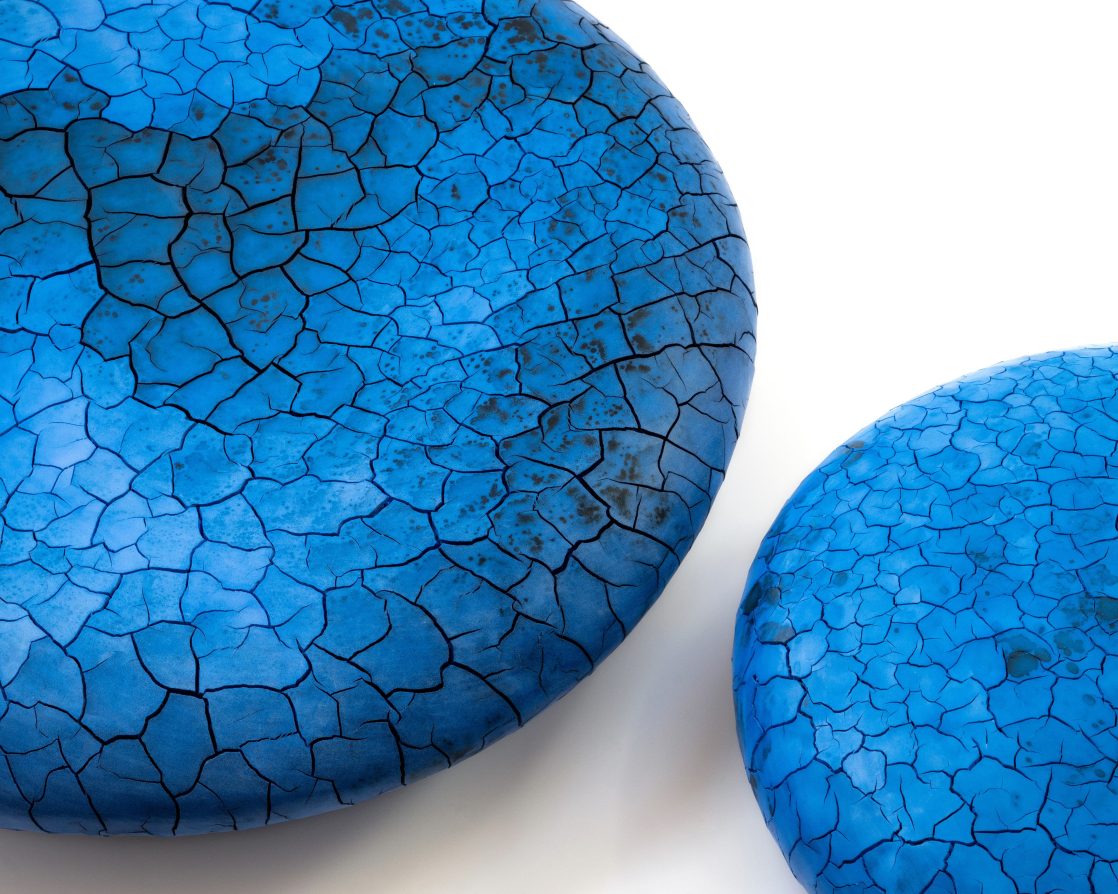
Lee began to make works in pigmented glazes rather than a pigmented porcelain body, which were imposing because of an unglazed white rim. Such borderlines drew out the form in space, and when applied to nesting pieces, the rims gave each set an expressive quality, akin to the ripples of water made from a stone disrupting the smooth surface of a pond. Whilst these works retained a gentleness that could be equated with Korean aesthetics, they also demonstrated a growing assertiveness and technical confidence that was a result of moving to a different country.
DEVELOPMENTAL TECHNIQUES
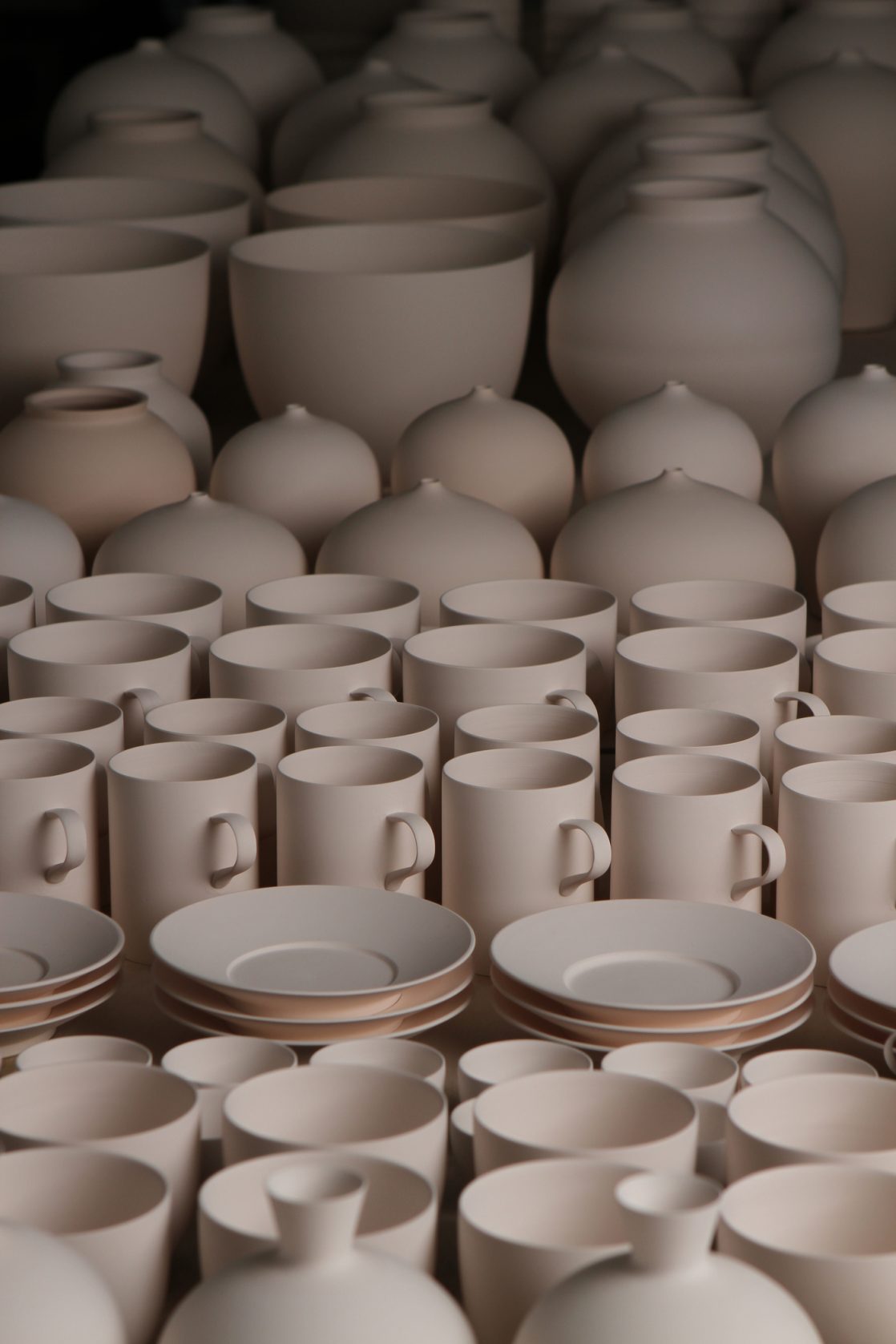
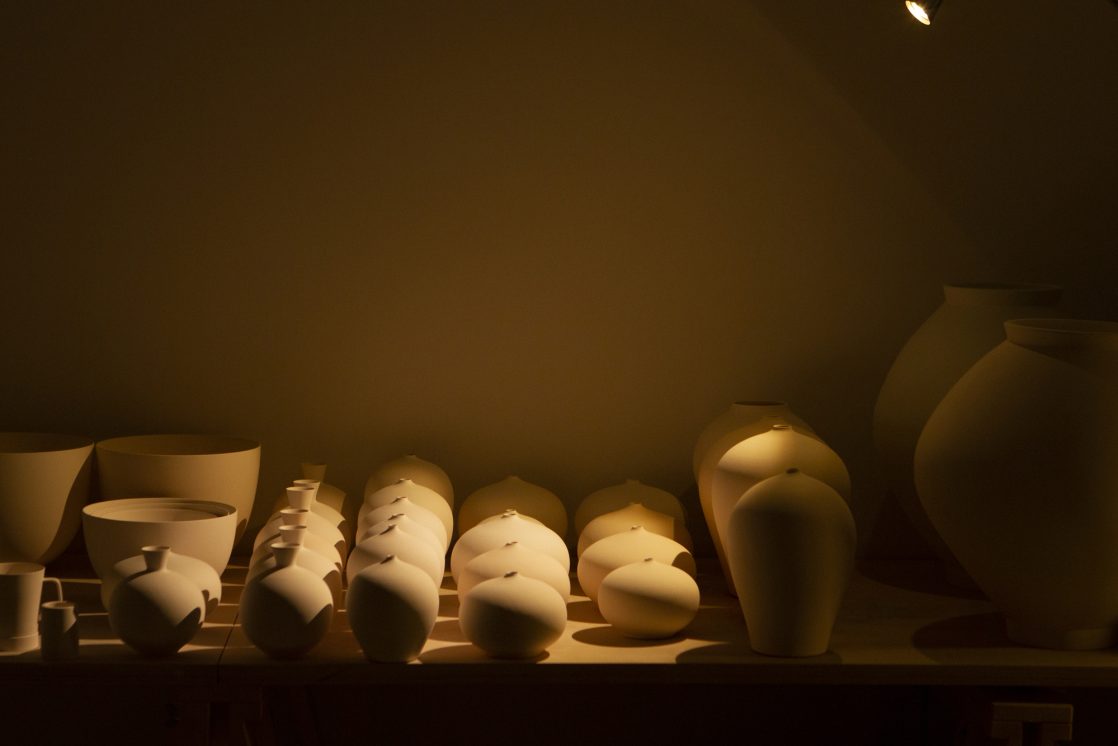
From 2019, Lee incorporated both moon jars and rounded jars into his vocabulary. Both stood as a personal development of Joseon forms; moon jars communicated a more Korean aesthetic sensibility, whereas the rounded jars were more Western. As the artist observed, ‘I tried to modernise the shape and make an effort to find my own silhouette.’ By 2020, his studio had been developed to accommodate much larger works including cut-sided vases, patterned cylinders, stacked plates and jars. Forms in grey and black pigmented glazes appeared alongside the existing shades of red, white and blue.
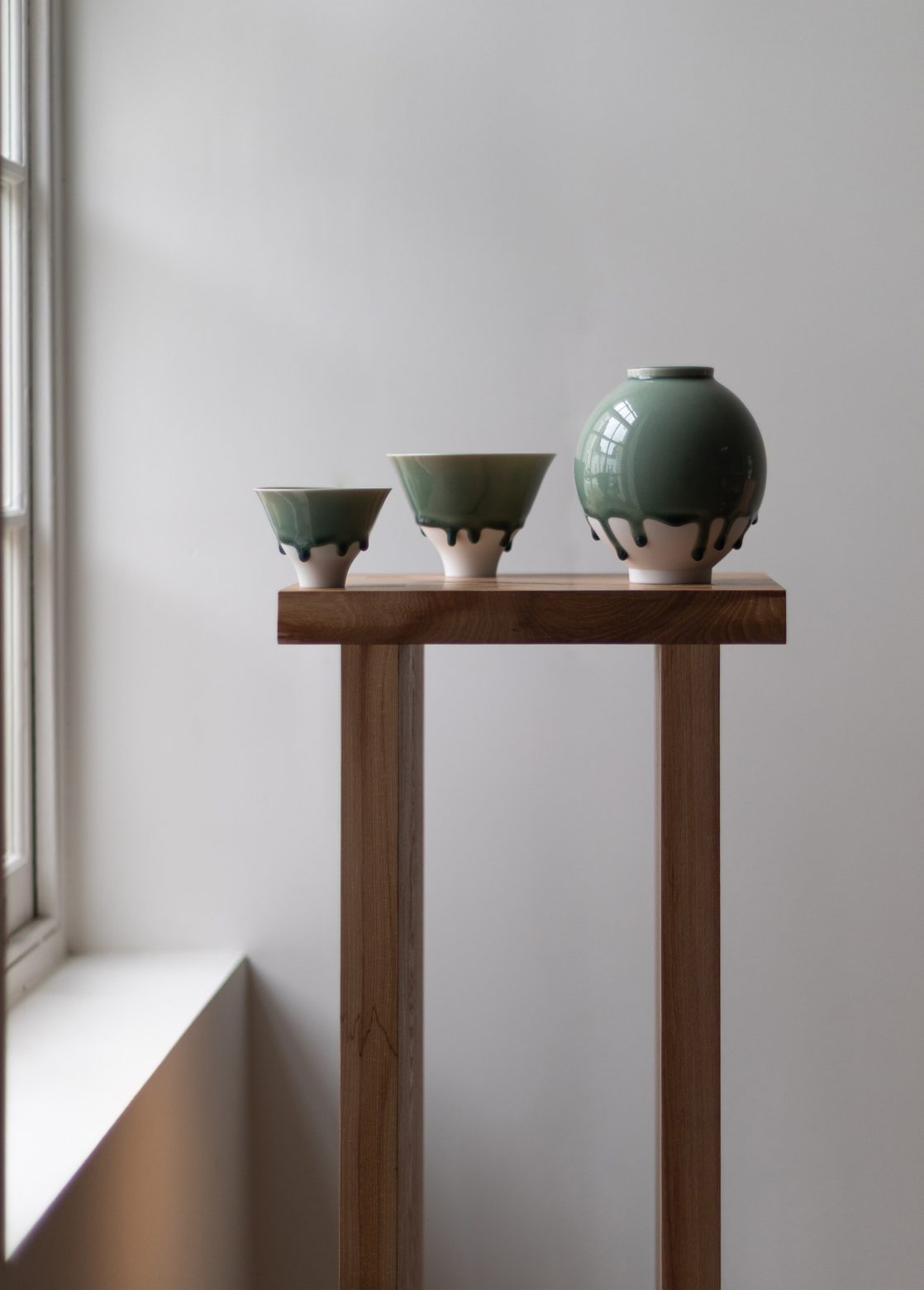
Although these pigmented glazed works were successful, a dramatic expansion to his practice came the following year when a work fired in oxidation was exhibited at the Flow Gallery in London in 2021. Lee produced a cylinder that was only partially glazed; the glaze had fallen halfway down the exterior of the vase but had pooled into a drip in one location. The contrast between the glazed and unglazed sections, and the broadly straight line of the glaze and its pooling into a drip, gave the cylinder extraordinary presence. The borderline – the point at which body and glaze intersected – emerged as a hallmark of his compositions.
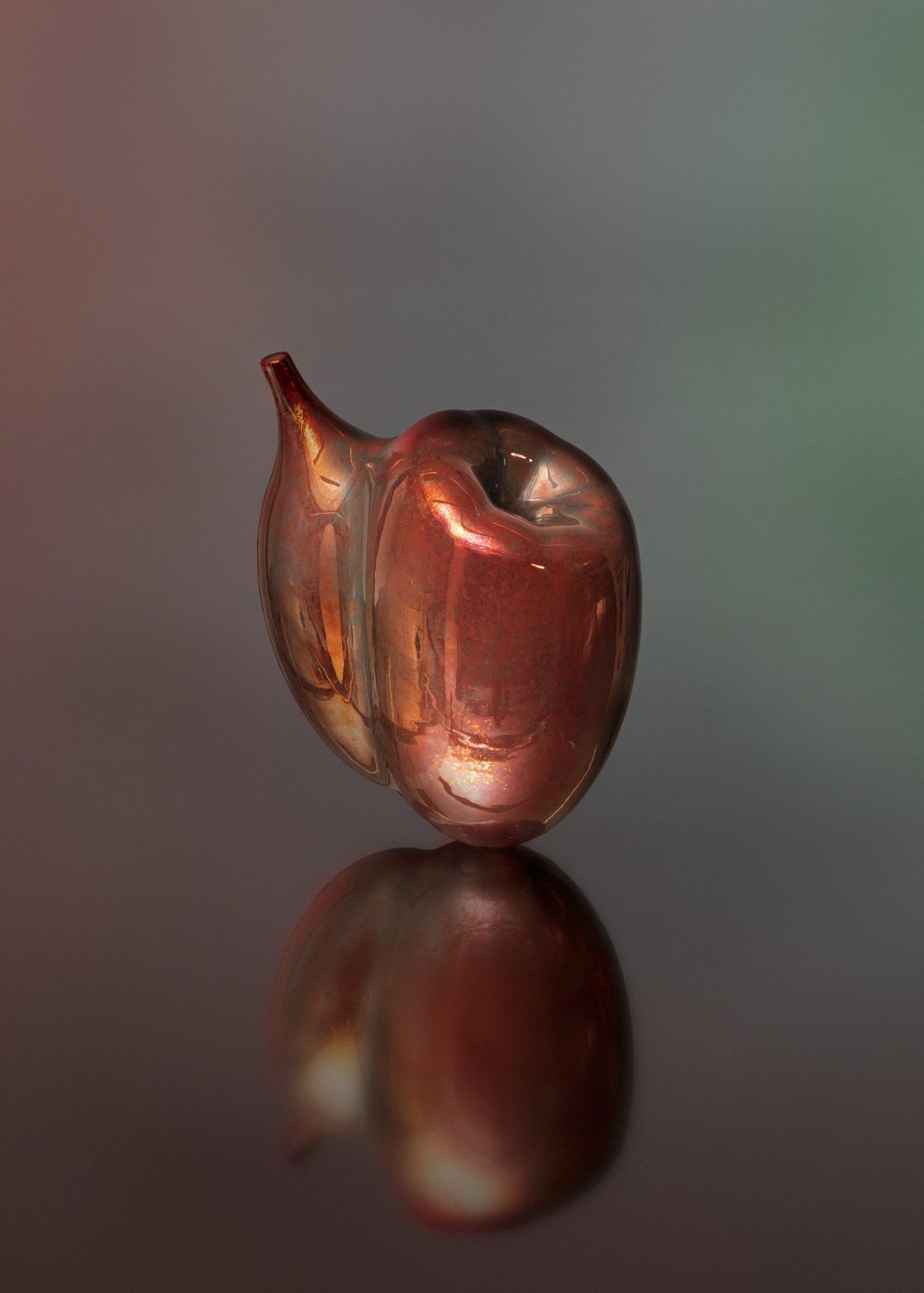
In 2022, Lee held a solo show at Beaux Arts in Bath of works produced from a year of experimentation into reduction firing in a new gas kiln. They consisted of an innovative range of pieces that investigated the contrast between different textures and materials. Glorious celadon glazes had been developed to run down each porcelain form, pooling into drips that became suspended in mid-air. The glaze had changed beautifully in the reduction atmosphere, producing concentrations and variations of celadon colour as it became thicker.
By now, Lee was becoming known for achieving a depth of colour, originally via pigmented glazes, and now through gradations of intensity of colour through reduction firing. It was surprising, therefore, that he also exhibited a bowl at Beaux Arts that moved away from forms in only one or two principal body colours.
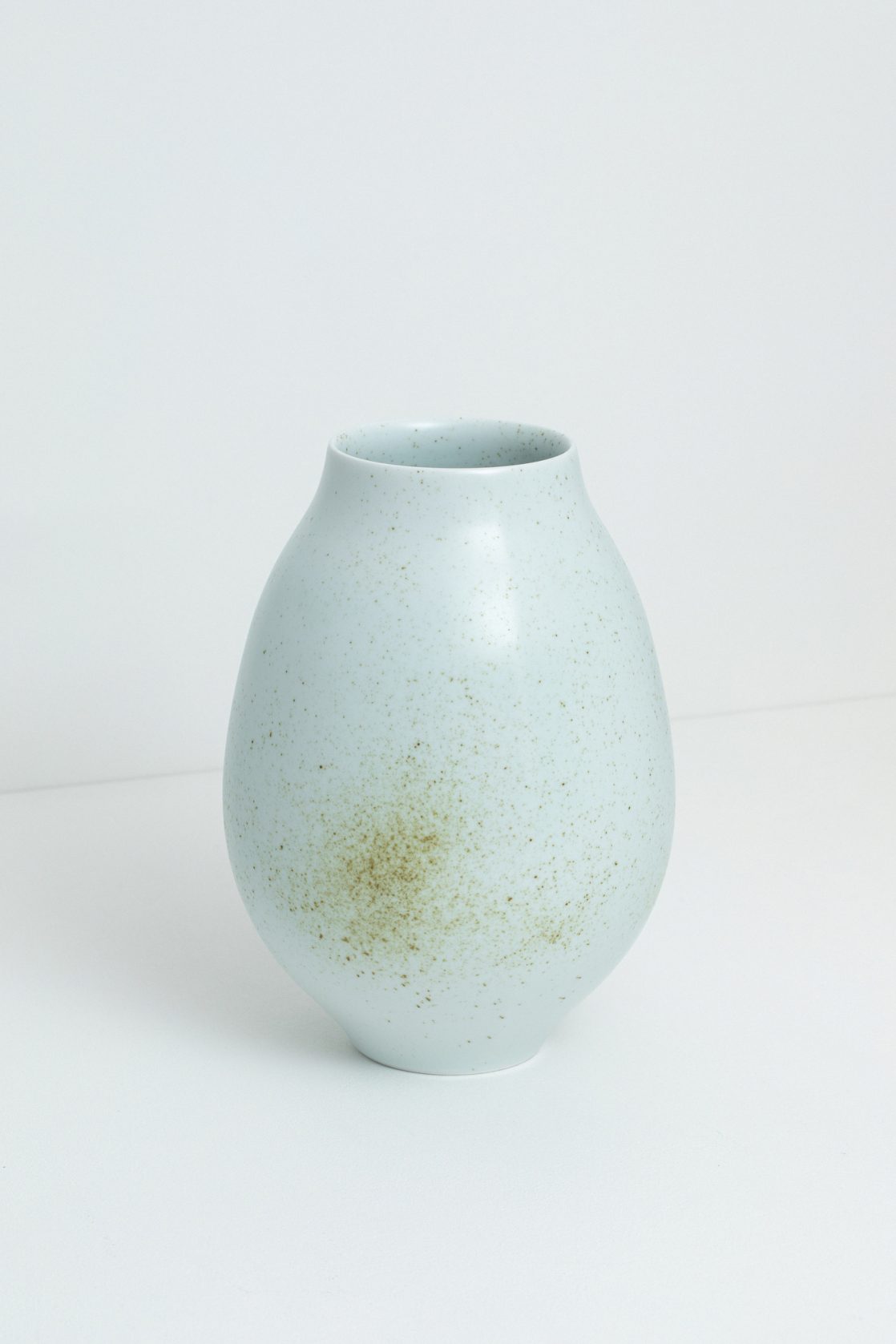
Lee had begun to experiment by spraying his pieces after firing so that they achieved a speckled, powdered-like surface. In one sense, such pieces attest to his restless experimentation, but they also demonstrate the extent of change when such works are compared with his BFA degree work from 2012. Long gone were the purity of surfaces to highlight form; instead, surfaces were more organic, one might even say a little imprecise. Yet, these effects served only to highlight Lee’s expressive vision. There is something satisfying about the adjacency of precision and imprecision; in Lee’s hands, it produces a gratifying equilibrium between perfection and imperfection.
NEW DIRECTIONS
While some potters might relax into a style that the pot-buying public have come to expect, Lee continued to experiment. He introduced new grey-bodied forms, producing a colder palette, perhaps a nod to the seemingly endless grey skies of the British winter. Conversely, he also developed dark grey-green glazes, descriptive of lush forest leaves on a wet spring day. Meanwhile, larger cylindrical vessel forms became the canvas for the drooping of glaze across an expanded horizontal plane. This produced startling new depths of colour from the viscosity of glaze that evoked natural phenomena. Titles like Sands of the Sea, Lush Forest and Snowy signposted towards the poetics at stake in each body of work.
Composition s, perhaps his most radical experiment to date, is comprised of carefully collected glaze drips from the firing of his pots, each drip was mounted on drawing paper in different formations. The small drips demand a Zen garden-like contemplation; the space between them becomes as important as the drips themselves, while the arrangement of different colours and glazes draws attention to the quiet variation that constitutes each composition.
They constitute another kind of border intersection too. In one sense, this intersection is produced by the differentiations of colour and material: glaze and drawing paper. Yet, they also constitute a conceptual border crossing: between product and by-product, ceramic object and glaze residue. And by framing them for the wall, they also cross the border between art and craft.
POTTERY LIFE
Lee’s most recent work, produced in the final months of his time in Britain, attest to his restless experimentation. For Ceramic Art London 2026, he produced a new series called Unclothed, pieces where the clay body is glazed to the interior, but the exterior is left exposed. Some pieces were fired in oxidation, while others were reduction fired.
Lee also made use of grey porcelain with fine garnet to create sensuous works that are as sculptural and tactile as they are functional. The forms are, as ever, developments from previous work; the lips widened and bodies elongated to create ever more imposing silhouettes. Here, the rim functions as the borderline: it is the interstice between interior and exterior, glazed and unglazed, the void waiting to be filled and the wall seeking to contain.
These latest works reveal how, in the eight years Lee has spent in the UK, his practice has shifted. In realising an expressive style very much his own, his work has revealed how the borders between material can be resolved into a composition that suspends tension via tranquillity; the meeting point between different elements is dynamic but controlled, provoking but reassuring. His technical capability is remarkable, but it is not deployed for its own sake.
The most important outcome for Lee is to achieve in his pottery a kind of poetic expression that simultaneously effaces his own presence. In achieving this, he has perhaps remained rather Korean. As Lee attested, ‘I have comparatively less desire to create a single “signature piece”. Rather than being defined by one masterwork, I wish to reveal my own world through consistent labour and a life lived in pottery.’
But I also find the insistence on combining different materials into one form also communicates something of the hybridity of being a Korean potter living and working in Britain. It speaks of the crossing of national boundaries, and an appreciation of the creative friction that such a crossing might foster, as it did for Leach, Rie and Coper.
Most importantly, as he returns to Korea this winter, his work stands against stylistic parochialism, wherever that might be. For Lee, an ending is always a new beginning.
For more details visit leejaejun.com; @jaejunlee_ceramics
Ceramic Review is the international magazine for contemporary and historical ceramics, ceramic art and pottery.
As a subscriber to the print magazine, you also get FREE access online to the entire Ceramic Review archive – going all the way back to our first issue in 1970. Digital subscriptions are online only.