X
Welcome to Ceramic Review
Ceramic Review is the magazine for contemporary and historical ceramics, ceramic art and pottery.
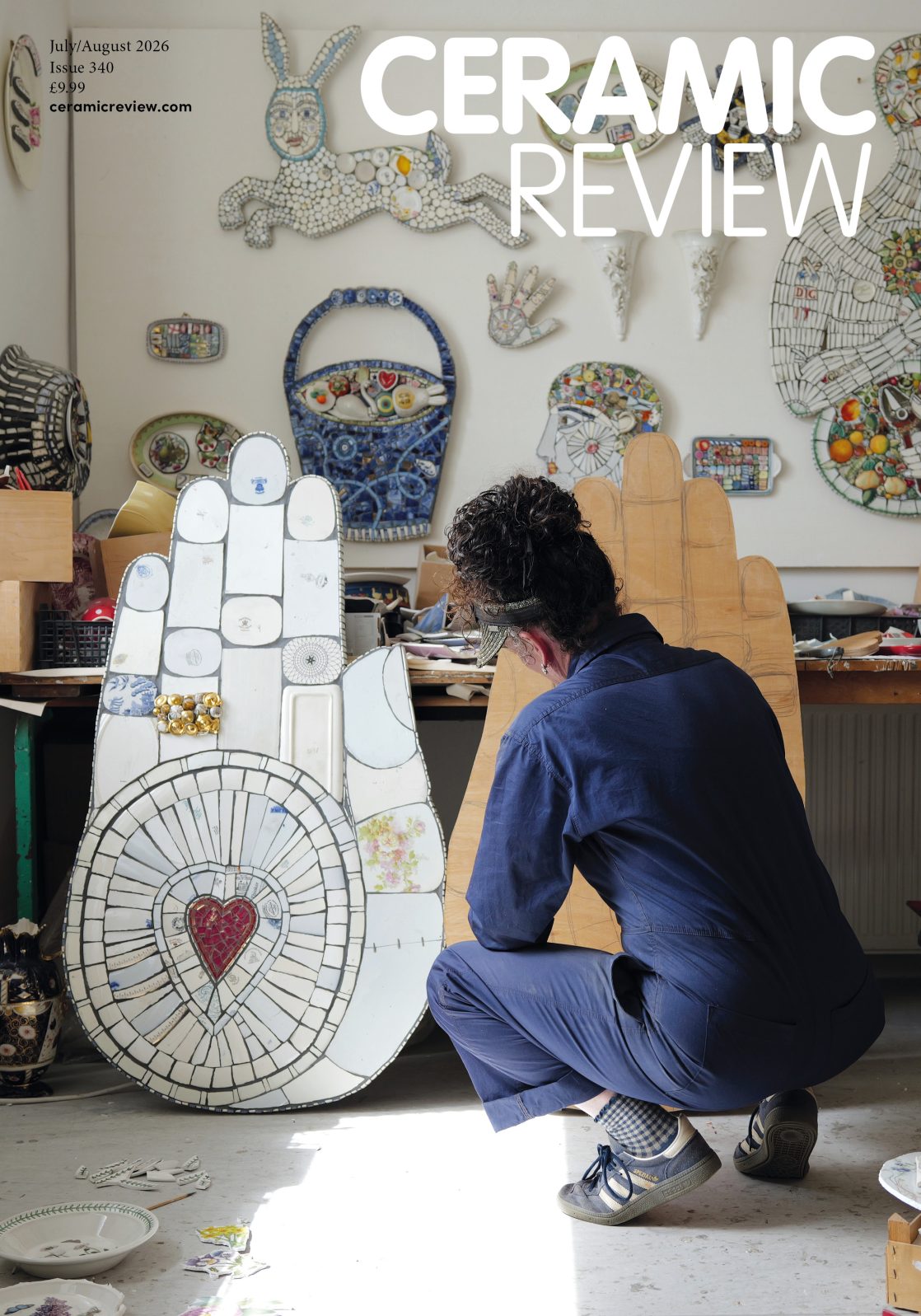
Ceramic Review Issue 340
July/August 2026
Ceramic Review is the magazine for contemporary and historical ceramics, ceramic art and pottery.
July/August 2026
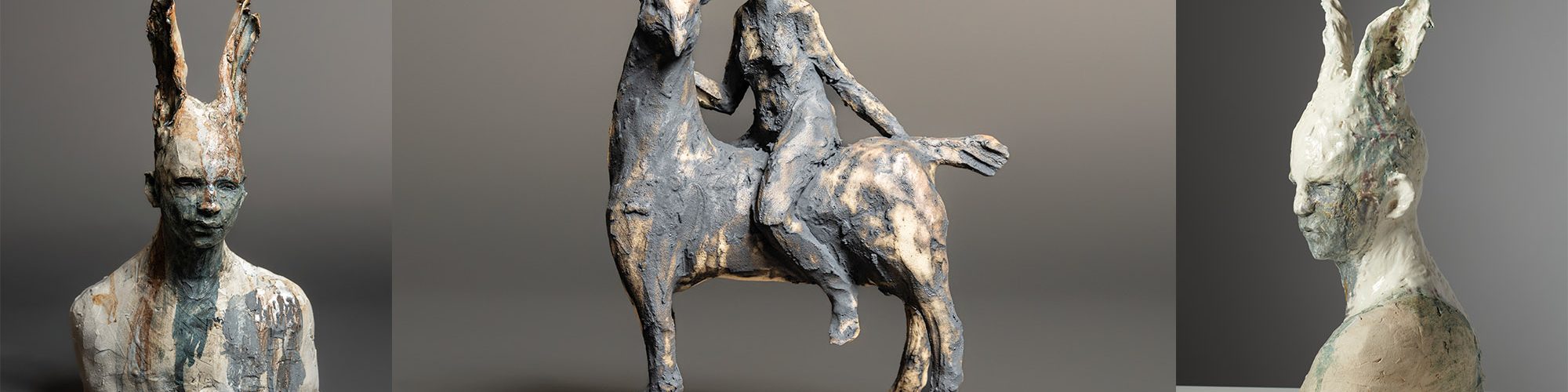
Natalie Baerselman le Gros uncovers the therapeutic foundations of Sharon Griffin’s figurative sculptures inspired by nature, mythology and an exploration of identity
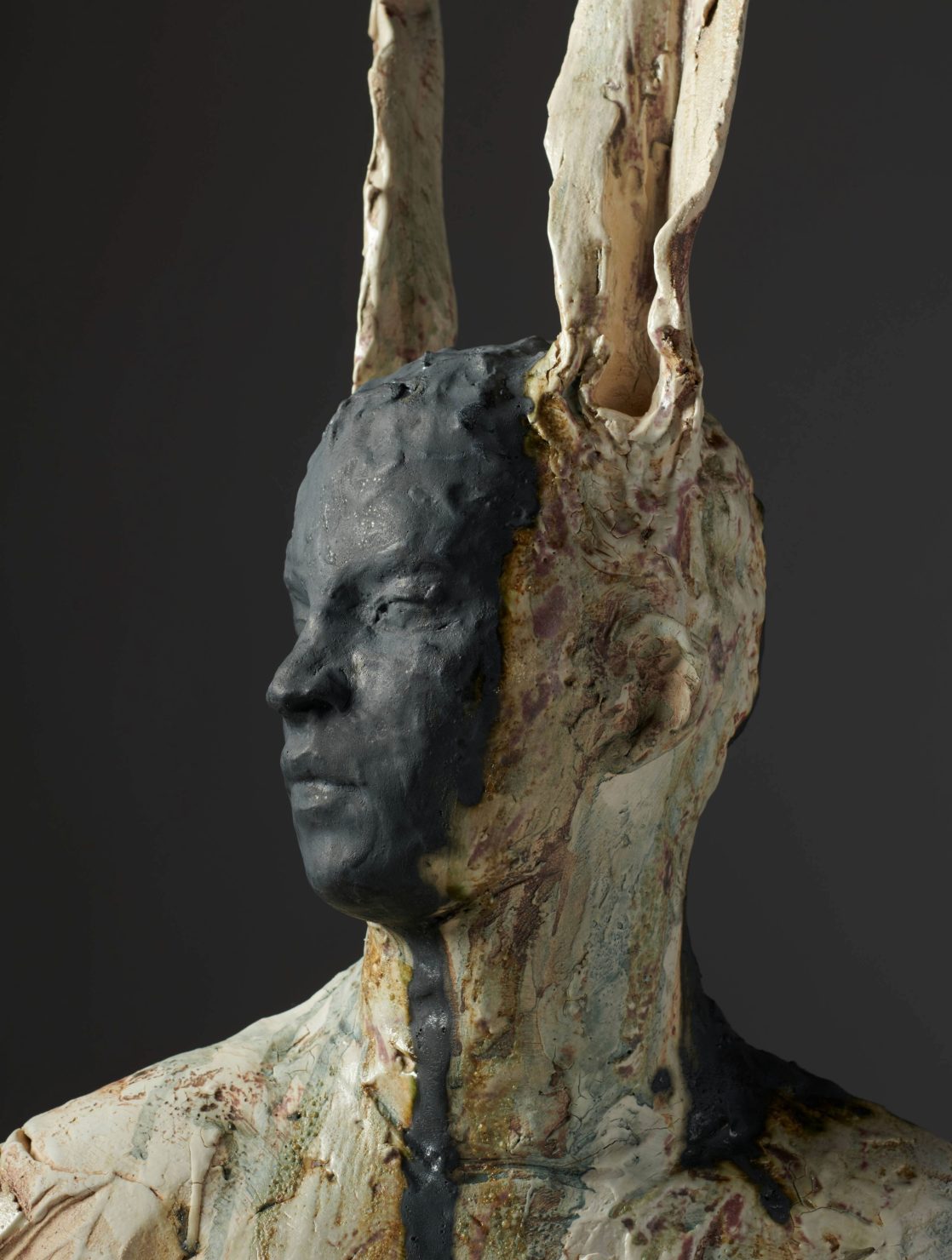
Sharon Griffin always starts with the breath, taking note of what she can see and smell, what is close to her and what is outside, always coming back to her self. For Griffin, the landscape is vital to her artistic and personal life, a story that has traversed many a hill and gorge. While clay may not be the beginning of that story, it is that which grounds her and
is the focus of her energy.
ARTISTIC HAVEN
Griffin sought out creative pursuits from a young age growing up in Shropshire. She loved school and having a difficult childhood meant the art room became her safe place. Encouraging teachers allowed her to paint and draw with little supervision and early on she learnt enjoyment in playful artistic pursuits.
Despite her familiarity with the art room, she didn’t experience much clay until joining Shrewsbury College, although she describes making a small owl figure around the age of seven that still adorns her studio shelves. At Shrewsbury, she found the pottery room, the quietest room in the college, and was taken under the wing of the art technician, Kate, who taught her to wedge clay and throw on the (until then) unused wheels.
Griffin’s teachers convinced her to go to university and so she applied to the University of Wolverhampton, beginning an undergraduate degree in Ceramics and Glass. As part of her course, she recalls an organised excursion, her first trip further than Wolverhampton from her childhood home of Telford, visiting various stone circle sites all the way up to St Andrews in Scotland. The trip ignited a budding interest in storytelling and mythology that would become important in the artist’s later work.
However, Griffin struggled with the rigid structure of university, taken more with an explorative practice. But, with the help of supportive teachers, including Dennis Farrell and Melanie Brown, she worked on a body of slab-built pots that she then decorated with motifs of the factory she was working at alongside her education. She used the pot walls as a canvas, trying to emulate the weight and fullness of the factory printing presses on the surface, sometimes using car paint and spray paint to illustrate the images she was so familiar with.
In 1997, newly graduated, she was able to afford a studio space under the government’s New Deal scheme. Here she continued to play with clay, making pots and animal figures but, without a kiln, she enquired at a local college to see if they would fire her works. The college agreed, on the condition she would do some teaching in exchange. At the age of 23, she found herself teaching painting, sculpture and pottery to A Level and BTEC students and she stayed for 15 years.
Griffin considers this the real beginning of her art education and enjoyed being amongst a team of 13 teachers, each an artist in their own medium and she travelled further still on more organised trips, to Paris, Amsterdam and Madrid. Being part of a well-funded art department had other benefits too and with support from her peers and an affiliation with
the University of Wolverhampton, she was able to undertake a Master’s degree alongside her teaching.
FORMING IDENTITY
Back at university, Griffin became increasingly interested in identity in an environment of new wave feminism and punk rock, and was influenced
by the Guerrilla Girls (an anonymous group of feminist, female artists devoted to fighting sexism and racism in the art world) and Poly Styrene of the band X-Ray Spex. She enjoyed how art, fashion, music and photography could be used as a means to explore and be creative with identity.
Aware of the prevalence of the male gaze in the media, heightened by the introduction of photo-editing software, Griffin used this instead as a tool to morph and stretch the bodies she was looking at. In her sculptures, she began to form bodies and faces, using clay as well as film, photography, sound and mirrors – ever experimental and intuitive with her making – and she continued painting. Working in both mediums, she experimented with surface and texture, striving to find ways to knit the two together.
The most significant and effecting change in Griffin’s work came after the heartbreaking loss of her baby at birth, not perhaps in the appearance of her sculptures but in their intention and depth of feeling. After a period of deep grief, she decided she only had one life, ‘I need to be living the best one I can,’ she reveals.
Away from her teaching position, she signed a studio lease with a close friend and started making, showing up for herself and allowing clay to help her on a healing journey.
She made thousands of porcelain birds, mostly dead at first but after a while they became animated. Sometimes they had cages, but then the cage doors started to open, the birds began to fly and became joyful. She shared this joyful making through local classes and pottery fairs, gathering an extended artistic family, many accessing clay for personal well-being much like herself.
She recalls a turning point during an angry walk in the local woods, dog in tow, when a deer stopped in her path, remembering its big ears and eyes, feeling a deep connection to the animal and the landscape that nurtured it. It prompted her to consider her emotions, the futility of that anger and fear. Not only did this experience catalyse Griffin’s interest
in psychology but also her characteristic melding of the human figure and animal biology, in particular those same big ears.
Griffin finds inspiration in painters – Kiki Smith, Jenny Saville and Käthe Kollwitz – and sculptors – in particular, Christie Brown, Susan Halls and Elisabeth Frink (all of whom she describes as goddesses). All these artists capture an essence of storytelling that Griffin manifests in her own work. Brown too shares an interest in psychology and the presence of the personal and collective selves. Griffin describes their works, and her own, as an invitation, a way of storytelling that leaves something out to allow others to bring their own perception. She describes this as a three-dimensional painting, narrative in the language of clay.
EMOTIVE IDEAS
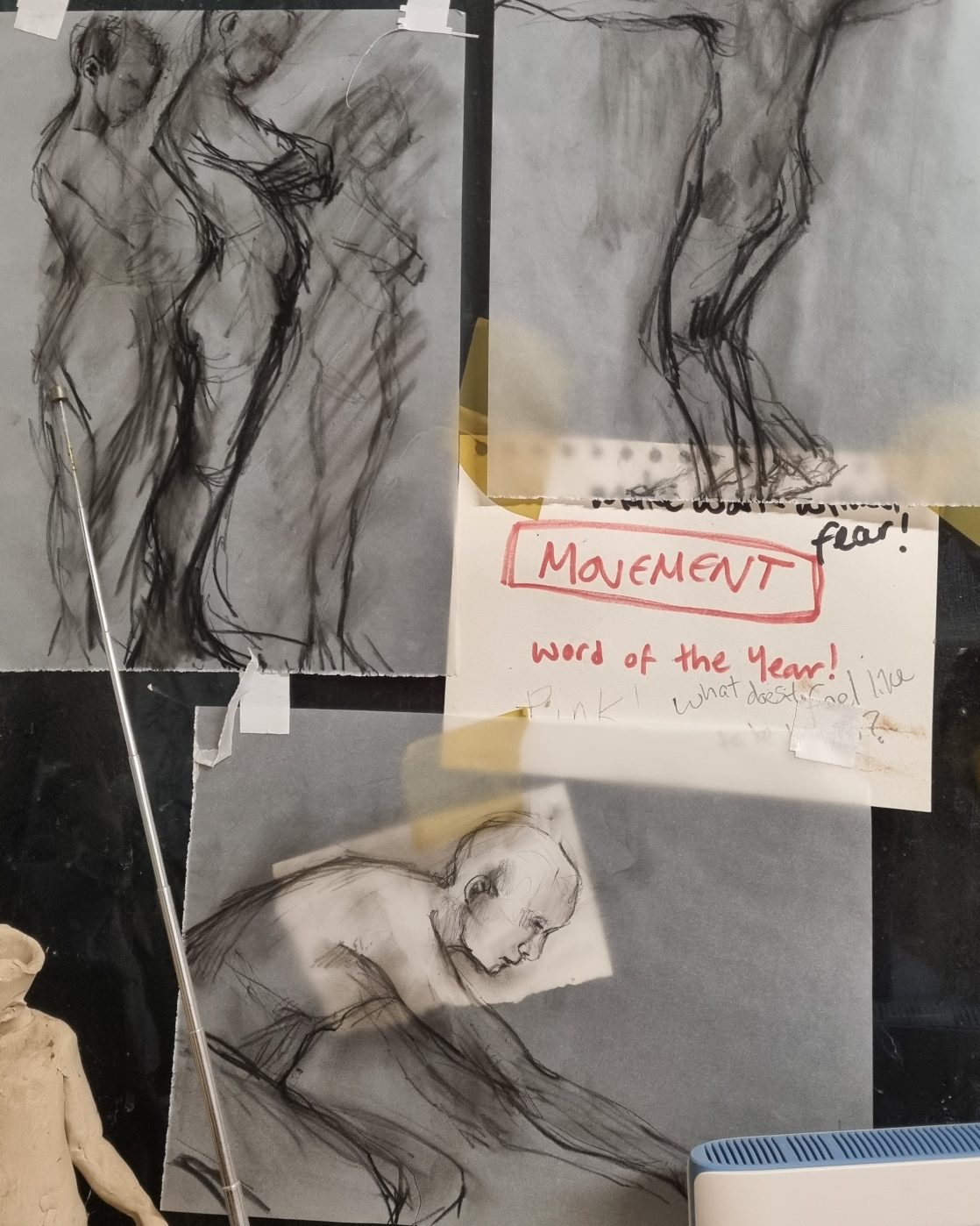
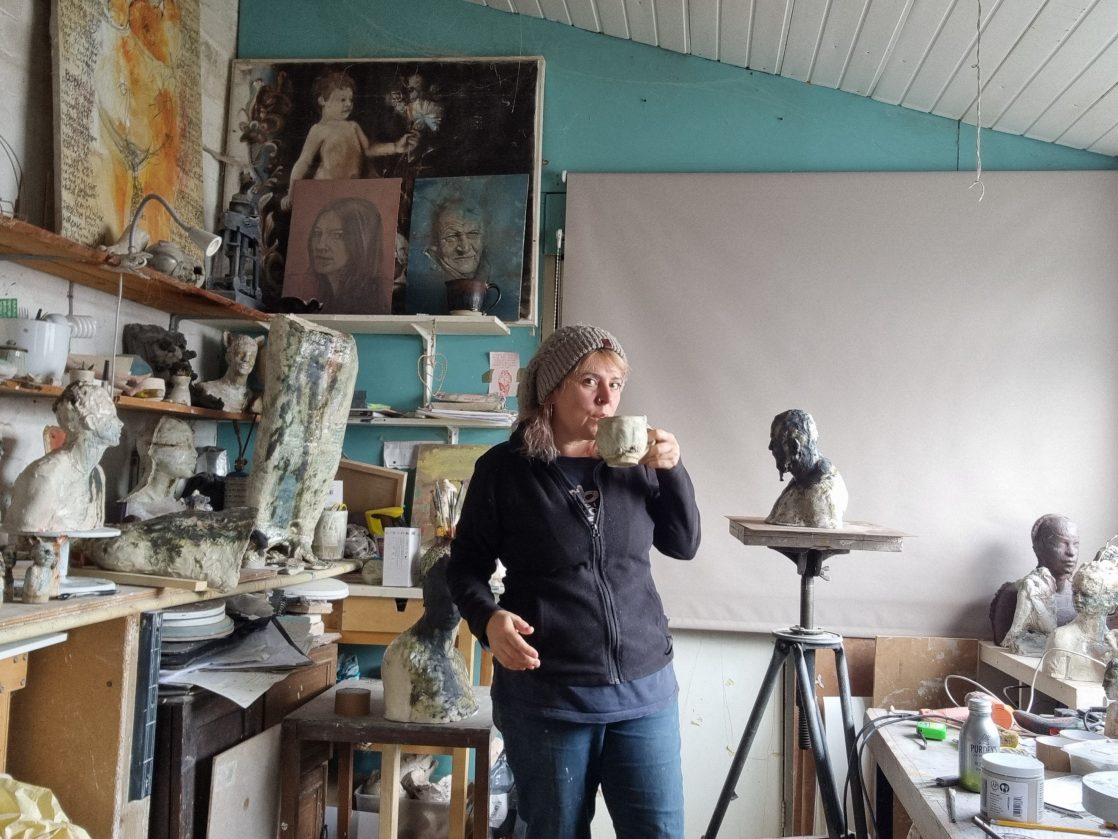
Each new work begins with Griffin acknowledging the energy around her during a walk in the woods, where she takes in the environment and her place within it, her body amongst it, sketching directly from nature as she goes. She has numerous sketchbooks in which she draws, collecting memories, dreams, maps, designs and photographs, a space she describes
as her ‘brain dump’. If an idea sticks, it comes out of the sketchbook and makes it on to her studio wall, where she explores it in greater depth with more sketching and painting.
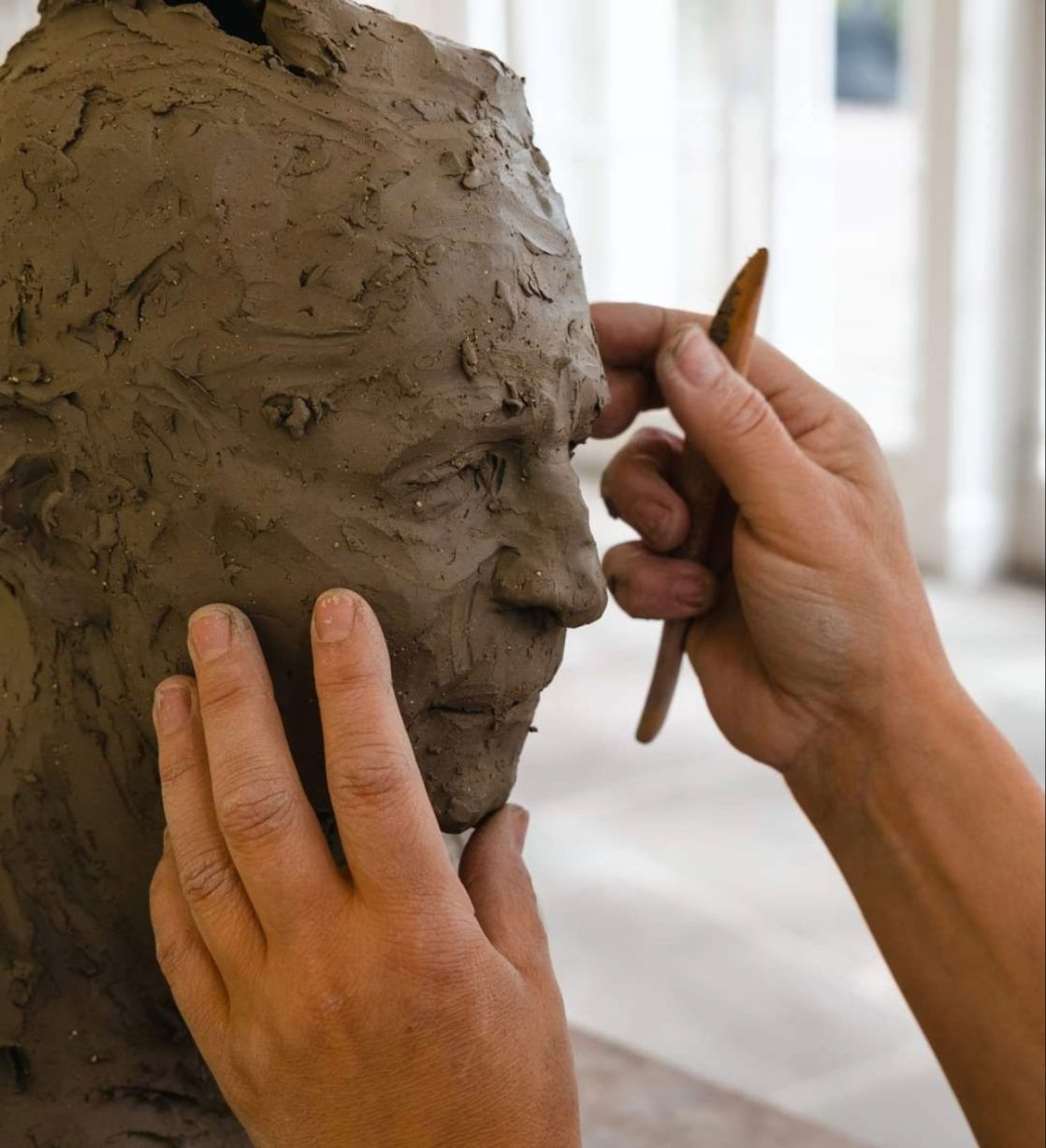
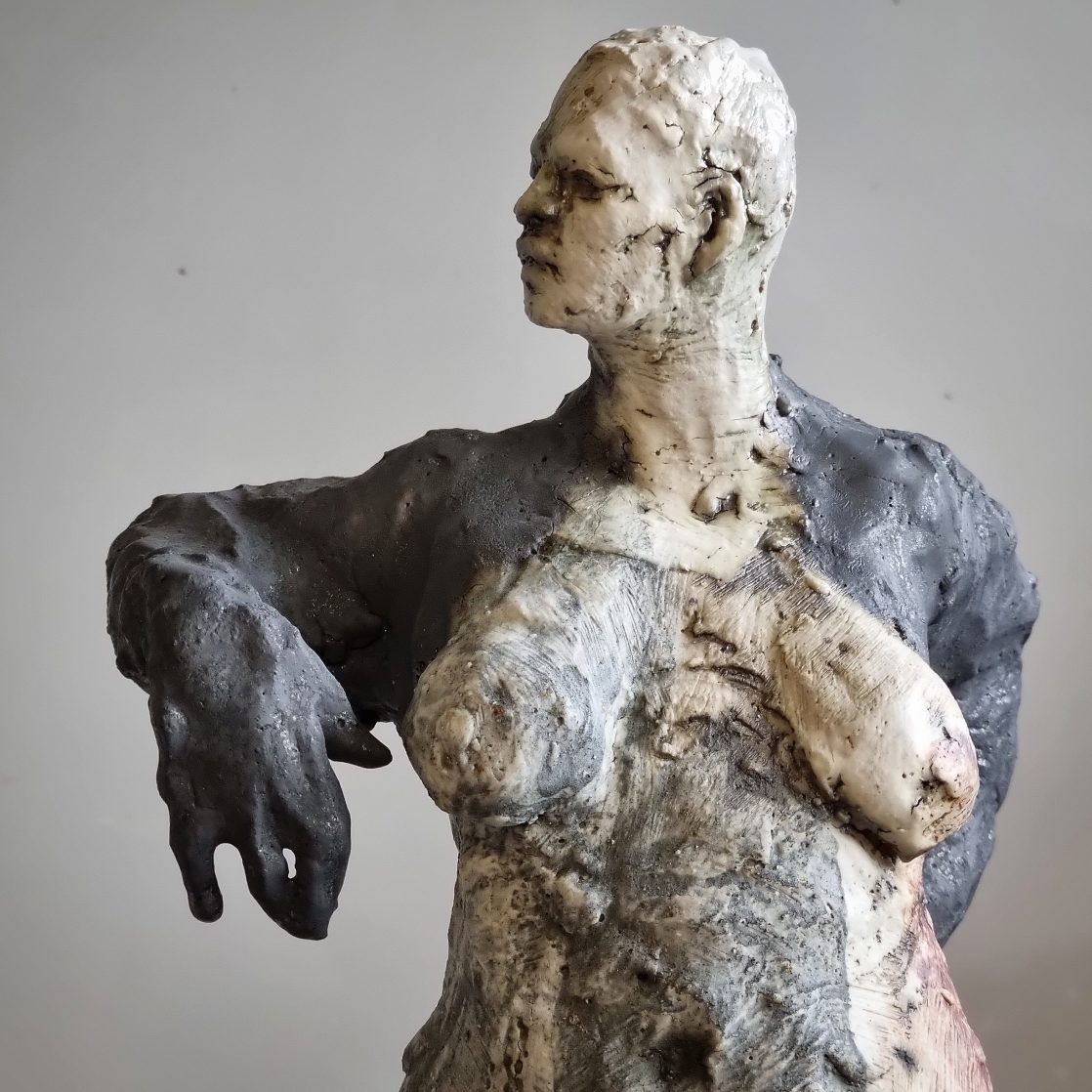
As ideas develop from the abstract into human form, Griffin may occasionally employ her children in photographs to interrogate the weight and lean of the body in a certain pose, starting to transform two-dimensional into three. Here, the image manifests in clay, working quickly with minimal tools to capture energy in the material, pushing and pulling from the inside of the figure’s form and out with her hands and fingertips. The effect of this quick working is the suggestion of a face, an identity, rather than aiming for verisimilitude, or a portrait in particular.
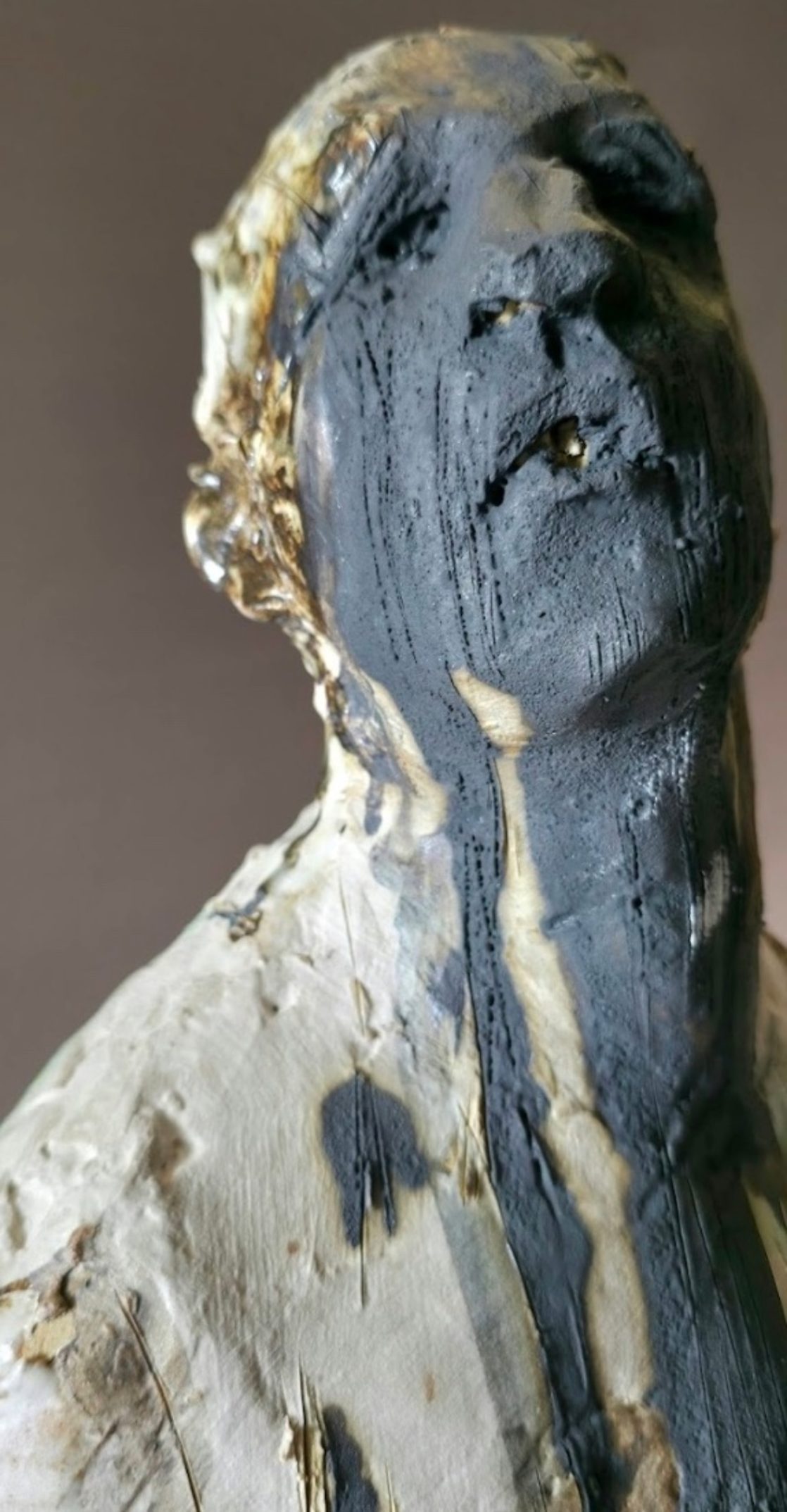
She likes to use an earthenware clay, particularly fond of an Etruscan Red with a high iron content (linked to her local Ironbridge, the birthplace of industry), but fired to stoneware temperatures, as well as making her own paper clay. Whilst the sculpture dries, Griffin considers colour, returning again to the landscape through drawing and painting. She throws some quick pot forms to experiment with glazes upon the clay surface and little palm-sized clay figures that allow the glaze to pool in the facial features. She only uses one glaze and keeps the recipe close to her chest. Once complete, the works have to pass one final test. Allowed to sit for some time, Griffin seeks to develop some unquantifiable feeling about the work to consider it successful, otherwise, it may end up in the garden, or perhaps, the skip.
Those that do make it into the gallery, and eventually someone’s home, are an invitation to not just inspect, but to enquire, to listen and empathise. To study one of Griffin’s sculptures at close quarters is to glimpse into its internal monologue. The life behind the sculpture’s eyes come from the artist’s masterful mark-making, the subtlety of expression, the tilt of posture seems to present them on the cusp of something. One has a desire to get to know them better. And yet, they are simultaneously otherworldly, with painted faces, elongated features and added ears and horns.
The sculptures tell you a story, of an alternative time and place but whether they are visitors from there or just playing dress up is hard to tell. Either way, they have something to share, something to pass down. Much like the works of Brown, Halls and Frink, they have a deep psychology, and one can imagine when your back is turned, the figures study you in return.
Looking to the future, Griffin has ambitions to develop the scale and presence of her work, beyond the quiet and introspective figures we know now, towards an image that ignites a viewer’s latent child. In doing so, she hopes to make less but with greater intention. For now, as everything begins it also ends with the breath. Griffin pauses, offering gratitude, noticing her breath, her energy and that which is all around her, in tune with her self, the goddess.
For more details visit sharongriffinart.com. Sharon Griffin will be exhibiting at Ceramic Art London, 8-10 May; ceramicartlondon.com and Space Gallery, Denmark, until 16 May; spacegallery.dk
Ceramic Review is the international magazine for contemporary and historical ceramics, ceramic art and pottery.
As a subscriber to the print magazine, you also get FREE access online to the entire Ceramic Review archive – going all the way back to our first issue in 1970. Digital subscriptions are online only.